
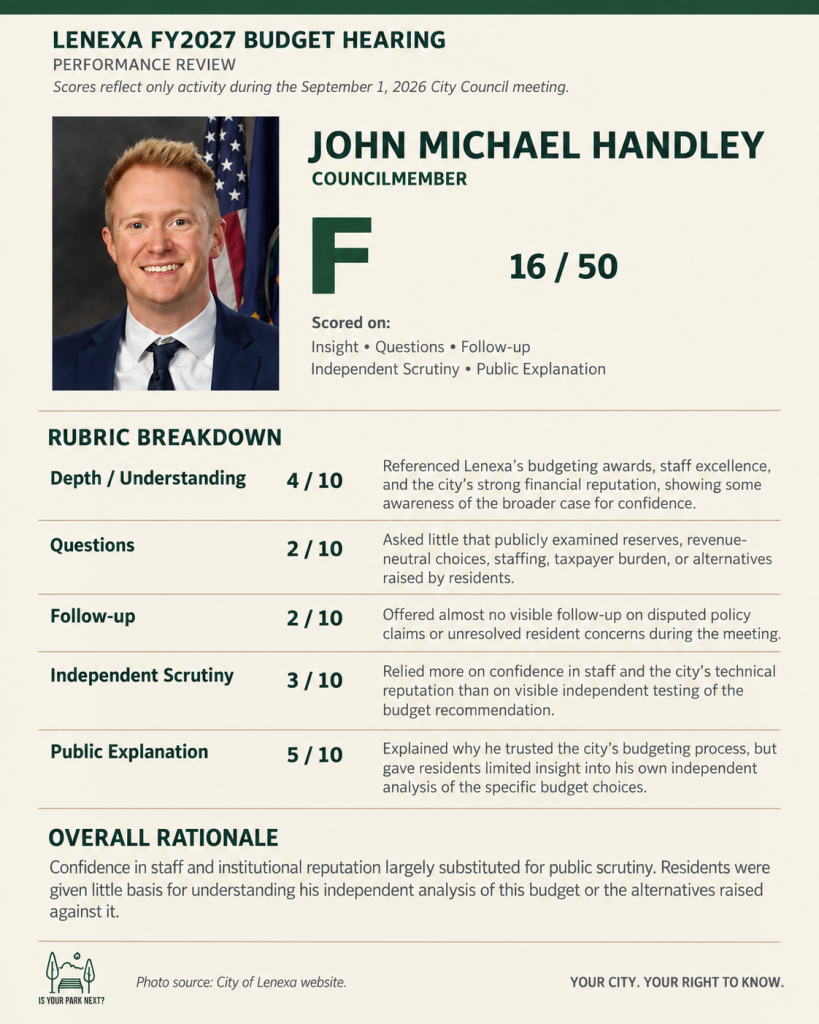
Handley’s comments were almost entirely about the quality of Lenexa staff and the city’s reputation for strong budgeting. He pointed to awards, praised the work, and said Lenexa has become used to that level of excellence.
Except no one was asking whether staff worked hard. The issue was whether this specific budget should be approved, whether Lenexa should exceed the revenue-neutral rate, and whether the governing body had tested the assumptions behind that recommendation.
Handley did not show that work publicly. He did not question the reserve level. He did not address the roughly $1.1 million above revenue neutrality. He did not engage with concerns about staffing growth, tax burden, or whether there were other realistic ways to get closer to revenue neutrality. He did not explain what part of the budget he had thought through or what evidence convinced him that the recommendation was the right one.
Instead, he relied on staff’s past performance and Lenexa’s financial reputation. Staff’s job is to prepare and defend the recommendation. The governing body’s job is to question it, test it, weigh other options, and decide whether it reflects the direction they want the city to take.
A councilmember can trust staff and still ask tough questions. In fact, that is exactly what should happen. Good staff work should be able to stand up to good questioning.
Without that questioning, the public is left with very little evidence that the recommendation was independently examined before the vote. The result ends up looking like rubber stamping.
That does not mean Handley needed to vote against the budget. He could have supported every part of it and still scored much higher if he had shown how he got there. But in this hearing, the public heard confidence in staff instead of independent analysis.
𝐓𝐨𝐭𝐚𝐥: 𝟏𝟔/𝟓𝟎 𝐅
Leave a Reply